
RBI’s Monetary Policy Review
On August 05, 2026, RBI’s Monetary Policy Committee (MPC) made following policy decisions:
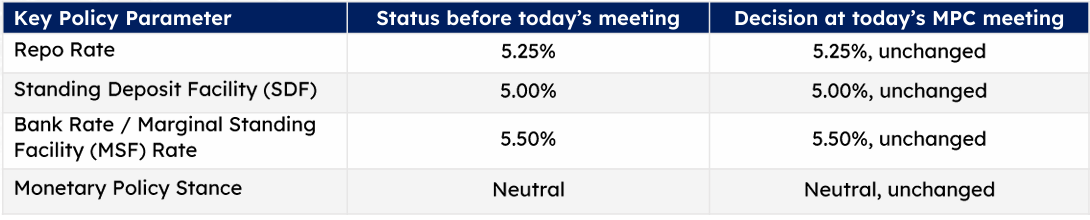
The RBI’s MPC voted unanimously to keep the repo rate unchanged at 5.25%. The MPC also decided to continue with the neutral monetary policy stance.
Executive summary of RBI’s press releases/ press conference
Global Economy:
- The West Asia conflict is hurting the global economy by disrupting major trade routes and supply chains . This disruption is increasing market volatility and weakening business confidence.
- Trade uncertainty continues as the US has imposed new tariffs.
- The global economic environment is becoming more unstable.
- Global growth is expected to slow down, while inflation for 2026 is projected to be higher vs. previous year.
- Some central banks have raised interest rates, while others remain cautious.
- Crude oil prices, currency markets and financial markets continue to fluctuate due to the uncertainty and changing intensity of the West Asia conflict.
Domestic Growth:
- Despite global uncertainty, India’s domestic economic activity remained strong in Q1 FY27, as shown by various high-frequency indicators.
- Private consumption was boosted by strong discretionary spending.
- Investment activity stayed steady, helped by continued government spending on infrastructure and construction.
- Weak monsoon may impact rural consumption, but allied farm activities and government schemes could cushion the effect.
- Urban consumption should stay supported by strong services activity and stable employment conditions.
- Investment activity should continue the back of high-capacity utilization, healthy credit growth and government focus on infrastructure.
- Real GDP growth for FY27 is projected at 6.7%. Overall risks to growth are evenly balanced.
Source : RBI
Domestic Inflation:
- CPI inflation rose to 4.4% in June 2026 after staying below the target for 16 straight months.
- El Niño continues to pose a major risk due to its impact on rainfall distribution.
- However, proactive supply management and adequate foodgrain stocks provide some comfort.
- Global oil prices remain highly volatile due to geopolitical events, making the near-term outlook uncertain.
- While overall inflation pressures are still moderate, there is a risk that higher food, fuel and input prices could spill over into broader inflation.
- CPI inflation for FY27 is projected at 5.0% while core inflation (ex-food and fuel) is projected at 4.3%.
Liquidity and Financial Market Conditions:
- Banking system liquidity averaged a daily surplus of INR 1.0 lakh cr since the June 2026 MPC meeting.
- Liquidity in the banking system is expected to improve further due to the usual return of currency during monsoon, government cash balance drawdown and special measures to attract capital inflows.
- Short-term money market rates, especially CP and CD rates, softened in July.
- Transmission in the credit market slowed during May–June due to rising deposit and lending rates.
- RBI will continue using two-way operations to ensure adequate liquidity in the banking system.
- The aim will be to keep the weighted average call rate aligned with the policy repo rate.
Outlook:
- We see the RBI’s FY27 outlook as slightly more constructive, with CPI inflation revised down by 10 bps and GDP growth revised up by 10 bps.
- The RBI’s overall tone of the inflation commentary appears dovish.
- In our view, the RBI remains cautious, and any tightening is likely to depend on sustained, broad-based inflation pressures rather than temporary increases in food or oil prices.
- While an October rate hike looks unlikely, we continue to expect the RBI to begin its rate-hiking cycle in FY27, with a 25 bps increase potentially materializing by the Feb 2027 meeting.






 2024 HDFC TRU