
When Liquidity Met Borrowing: RBI’s OMOs in FY26
RBI’s Open Market Operations (OMOs), often described as a simple liquidity tool, took on a much bigger role in FY26: against the Centre’s gross borrowing of about ₹14.6 lakh crore, RBI’s OMO purchases absorbed a large part of the supply, helping keep bond market conditions orderly and yields from rising too sharply. This note explains how OMOs work, reviews RBI’s 10-year OMO history, and then focuses on FY26 to show why the line between liquidity management and indirect fiscal support has become so important for treasury investors.
Introduction
Open Market Operations (OMOs) are one of the RBI’s main tools to manage liquidity in the banking system and interest rates in the economy. In recent years, however, OMO purchases have also quietly helped absorb a large chunk of the Centre’s bond supply, which has led the market to argue that RBI is, in effect, “funding” the fiscal deficit to some extent.
This primer explains:
- What OMOs are and how they work.
- What RBI has done in OMOs over the last 10 years.
- How OMO purchases in FY26 compared with Central Government borrowing.
- Why the “fiscal funding” argument exists – and how to look at it.
What are RBI’s Open Market Operations?
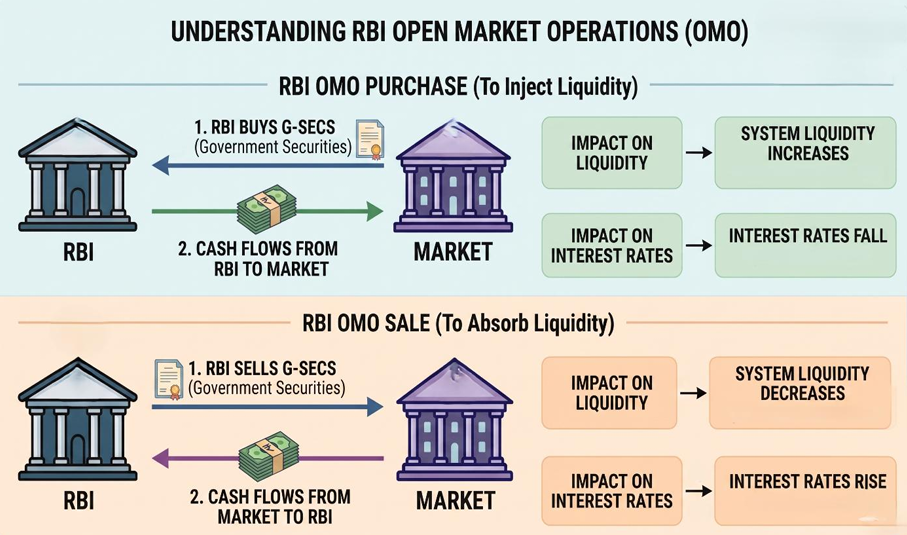
In simple terms, Open Market Operations (OMO) are when the RBI buys or sells government securities (G‑Secs) in the secondary market.
- When RBI buys G‑Secs, it pays money into the banking system, adding liquidity.
- When RBI sells G‑Secs, market pays money to RBI, taking liquidity out.
Source: RBI, HDFC Tru
RBI carries out OMOs mainly to:
- Manage durable liquidity in the banking system.
- Interest rate stabilization by altering the bond demand supply dynamics.
- Yield curve shaping through simultaneous buy and sale of G-secs.
OMO is technically a monetary‑policy / liquidity tool, not a budgeted fiscal‑financing route, but the effect on bond markets can look like direct support for government borrowing.
OMOs in the last 10 years – key trends
Over the last 10 years, RBI has used OMOs in different ways, depending on the macro and fiscal backdrop.
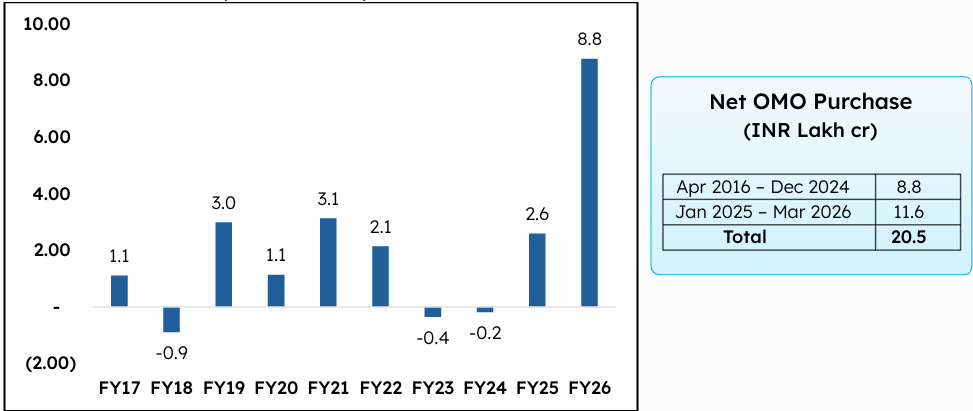
Net OMO Purchase (INR Lakh cr)
Source: RBI, HDFC Tru; Note – positive value denotes OMO purchase and vice-versa
- FY26 is a clear outlier. Net OMO purchase jumped to INR 8.8 lakh crore, far above every other year in the 10-year series. That shows RBI was exceptionally active in absorbing bond supply in FY26.
- OMO has mostly been supportive, not restrictive. In 7 out of 10 years, RBI was a net buyer of government securities; only FY18, FY23, and FY24 saw net sales or near-neutral stance. This reinforces the idea that OMO is often used to support liquidity and smooth borrowing conditions.
- The post-pandemic pattern is important. After smaller or negative net OMO in FY23–FY24, RBI turned sharply positive again in FY25–FY26. That suggests the central bank stepped in more aggressively when market absorption of large government borrowing became a bigger concern.
FY26 OMO vs Central Government borrowing
In FY26, the Centre’s gross borrowing through issuance of government securities was very high. OMO purchases of INR 8.8 lakh cr accounted for 60% of Centre’s gross market borrowing and 82% of net borrowings in FY26.

Source: RBI, HDFC Tru
This had two important effects on the bond market:
- Less pressure on bond yields– Without RBI buying such a large share, yields would likely have hardened more sharply due to oversupply.
- Smoother execution of the borrowing calendar– Primary dealers and market participants could place bonds more easily, knowing that RBI was a large, steady buyer in the secondary market.
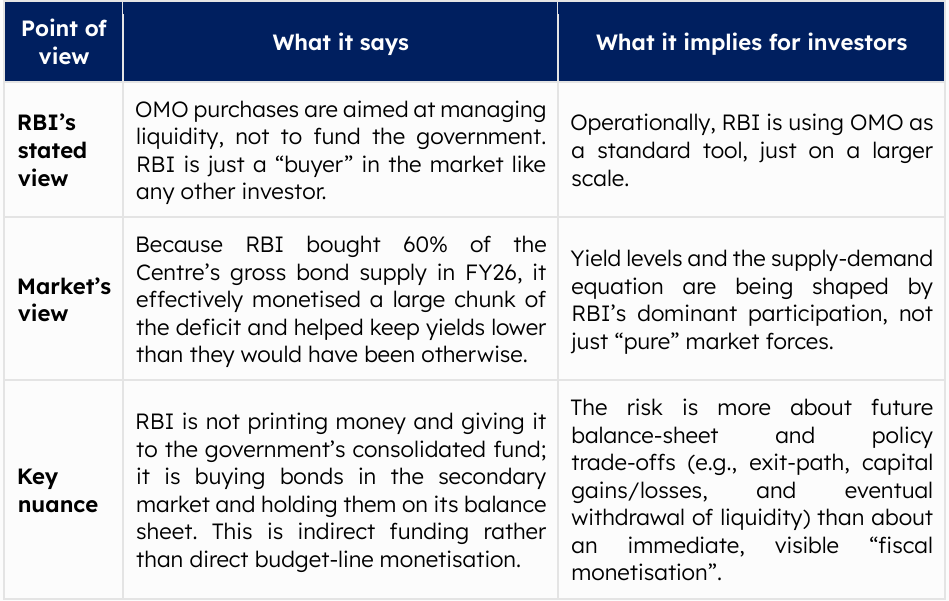
How to read the “fiscal funding” argument
Market participants including economists often say that RBI’s OMO purchases in FY26 were effectively a form of fiscal financing, even though RBI officially calls OMO a liquidity‑management tool. Here’s how to think about this nuance:
Practical takeaway for fixed income investors
For treasuries and large investors, there are three key messages from this OMO story:
- OMO is not just “theory”– In FY26, RBI’s OMO purchases were a big, active player in the G‑Sec market, absorbing almost 60% of the Centre’s gross bond supply and helping keep yields relatively contained despite heavy issuance.
- RBI’s liquidity‑management is now closely tied to fiscal‑financing realities– When the Centre runs a large borrowing plan, the likelihood of large OMO purchases increases, and this can put a soft cap on yields.
- Watch the “fiscal–monetary nexus”– Even though RBI calls OMO a liquidity tool, the economic effect is that it helps the government place its bonds more smoothly. Over time, the question will be when and how RBI exits this stance (e.g., via OMO sales, longer‑term liquidity tools, or balance‑sheet adjustments).
Our take:
With budgeted gross central government borrowing elevated at around INR 16 lakh cr in FY27, we expect the RBI to retain a bias toward OMO purchases to smoothen the large supply calendar and support orderly absorption of government securities. While OMOs are officially a liquidity tool, recent experience shows that they can also help the market digest heavy sovereign supply and prevent an abrupt rise in yields.






 2024 HDFC TRU