
Rising “AI” Concentration Risks in Global Equities

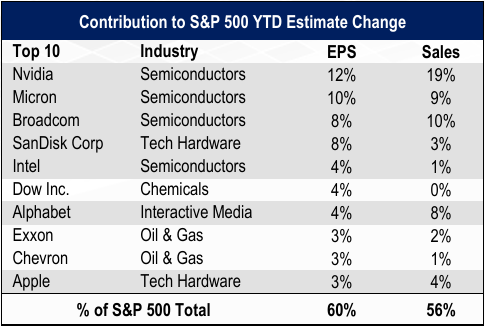
Global equity benchmarks have become unusually dependent on a single theme: “AI”. The Mag-7 is currently ~35% of the S&P 500, TSMC is ~58% of MSCI Taiwan, and Samsung Electronics plus SK Hynix make up more than 50% of MSCI Korea, with the same names dominating MSCI EM and MSCI Asia (ex-Japan) indices. Earnings momentum is even narrower than market caps suggest, with just 10 stocks reportedly accounting for ~60% of recent S&P 500 EPS revisions. This signals that a single-theme drawdown, whether from an AI capex reset, a DeepSeek-style efficiency shock, or geopolitical disruption to Taiwan / South Korea, would transmit simultaneously across global equity markets.
Executive Summary
Global equity benchmarks have rarely been this dependent on a single theme. The IT sector in the US now makes up >40% of the S&P 500. TSMC alone accounts for around 58% of MSCI Taiwan Index and 44% of TAIEX. Samsung Electronics and SK Hynix together represent >50% of MSCI Korea Index. At the same time, almost all of the recent positive earnings momentum at the index level, across both developed and emerging markets, is being driven by AI infrastructure beneficiaries, e.g., semiconductors, hyperscalers, memory, and selected enablers.
Concentration is not new, but it has two implications for portfolios – (i) it is partly a justification for current valuations, and (ii) it is also the mechanism by which a single-theme drawdown could transmit broadly.
Figure – 1: Such has been the outperformance of the info tech sector in the US that the S&P 500 IT / Semiconductor Index have delivered 24% / 36% CAGR returns over the last 10 years vs. the S&P 500 (ex-IT) Index at just 10%…
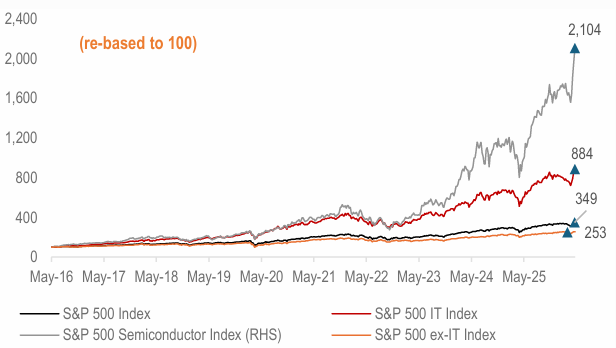
Source: Bloomberg, HDFC TRU.
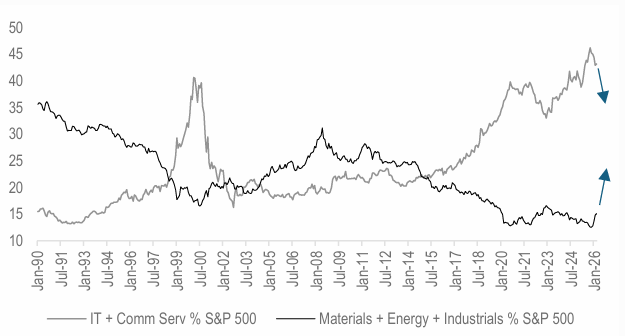
Figure – 2: …The IT & Communication Services sector now accounts for ~43% of S&P500, the highest concentration in modern S&P history….
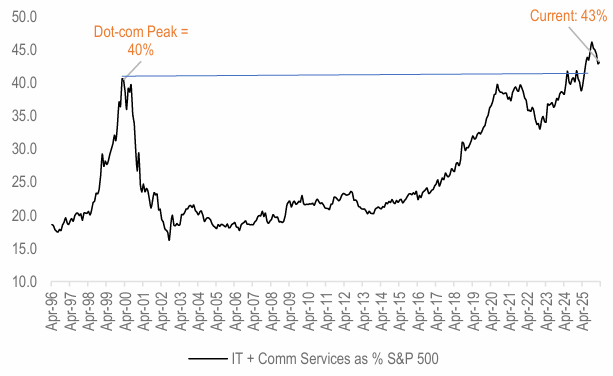
Source: Bloomberg, HDFC TRU.
Figure – 3: Even in Emerging markets, we see a similar story, with the tech sector outperforming the broader index materially (10Y CAGR of ~23% for the MSCI EM Info Tech Sector vs. a paltry ~7% growth for the MSCI EM Index)…
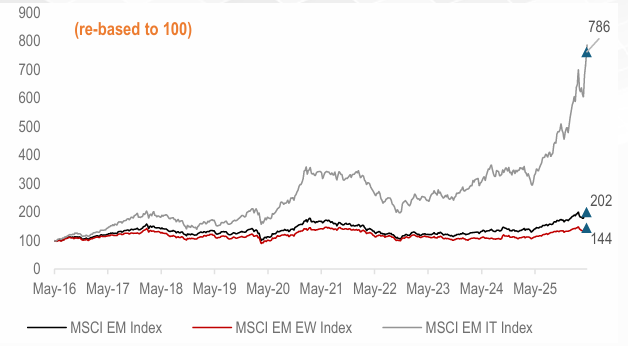
Source: Bloomberg, HDFC TRU.
Major Global Equity Indices have become AI / Semiconductor Sector Proxies…
1) S&P 500. The Mag-7 (Apple, Microsoft, Nvidia, Amazon, Meta, Alphabet, Tesla) today makes up roughly 35% of S&P 500 market cap, up from ~18.5% as of early 2020.
Figure – 4: Magnificent -7 stocks now account for more than 1/3rd of the S&P 500 Index…
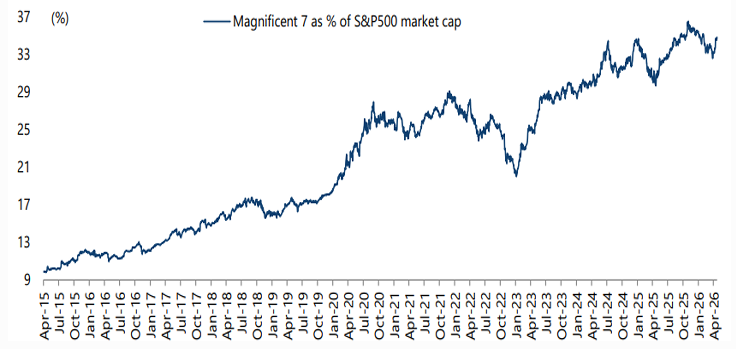
Source: Bloomberg, Greed & Fear Report, HDFC TRU.
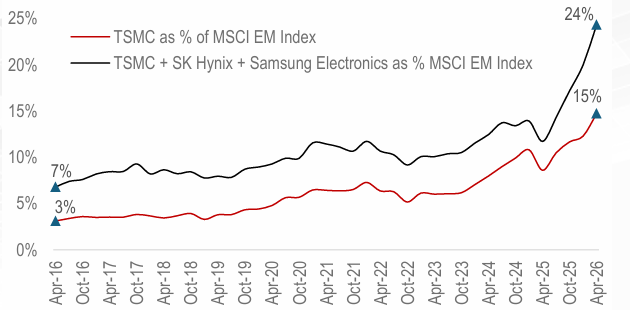
2) MSCI Emerging Markets. Concentration is more acute, not less. TSMC alone accounts for around 13% of the index. The top-10 holdings represent ~32% of the benchmark, and five of those are from a single sector — TSMC, Samsung Electronics, SK Hynix, Delta Electronics and Hon Hai. A passive EM allocation today is, in large part, an Asian semiconductor allocation.
3) Single-country indices in Asia. The picture sharpens further at the country level:
- MSCI Taiwan Index: TSMC accounts for roughly 58% of the index weight on a free-float market capitalization basis. Tech-related stocks now make up about 86% of the MSCI Taiwan Index.
- MSCI Korea Index: Samsung Electronics and SK Hynix together represent >50% of weight. IT sector represents ~60% of the index weight. The South Korean Index has rallied dramatically through 2025–2026, with both names contributing the lion’s share of the move.
Figure – 5: Three Semiconductor stocks (i.e., TSMC, SK Hynix and Samsung Electronics) comprise almost ~24% of the MSCI EM Index today…
Source: Bloomberg, HDFC TRU.
What is driving the AI / Semiconductor rally?
1) Hyperscaler capex at unprecedented scale. The five largest US hyperscalers (Microsoft, Alphabet, Amazon, Meta and Oracle) are on track to spend a combined $700 bn on AI infrastructure in 2026, up from roughly $380 bn in 2025. This spending flows directly into the revenue lines of the chipmakers, memory producers, networking equipment vendors, and power suppliers that dominate today’s index leadership.
Figure – 6: US real AI-related capex, rose by ~20% YoY in 4QCY25, while non-AI capex was down by ~3% YoY…
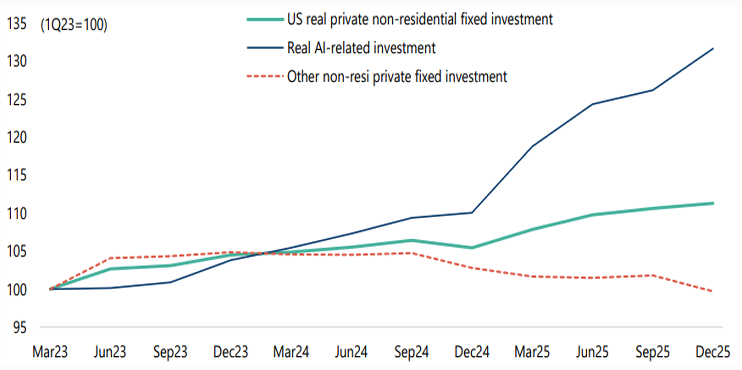
Note: AI-related capex includes real private fixed investment in information processing equipment, software and data center construction.
Source: Bureau of Economic Analysis, Greed & Fear Report, HDFC TRU.
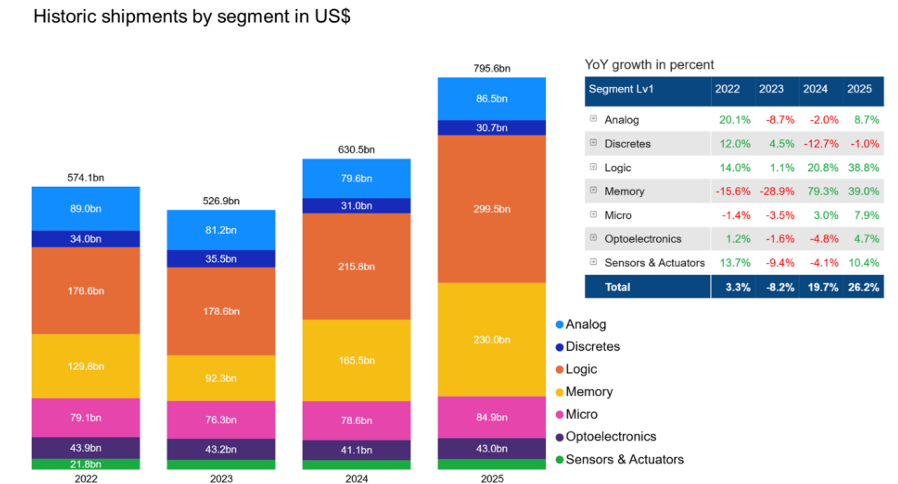
2) A genuine memory and logic supercycle. Demand for high-bandwidth memory (HBM) and leading-edge logic has outstripped supply, with TSMC publicly stating it expects AI demand to exceed capacity through 2027. SK Hynix, the dominant HBM supplier to Nvidia, has seen quarterly profits jump multi-fold. Micron’s 2026 EPS estimates have been revised up by triple-digit percentages.
Figure – 7: Logic and Memory Shipments Drive Market Growth
Source: World Semiconductor Trade Statistics, HDFC TRU.
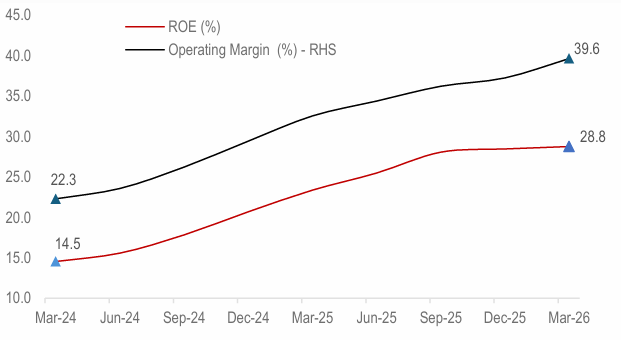
Figure – 8: MSCI EM Asia Semiconductor & Semiconductor Equipment Index quarterly performance; both ROEs and Operating margins have almost doubled over the last 2 years (Mar-24 vs. Mar-26)…
Source: World Semiconductor Trade Statistics, HDFC TRU.
The Earnings Picture: AI is doing most of the work
Concentration is uncomfortable when valuations diverge from earnings. The pushback to the bear case has been straightforward: earnings have been keeping up. The data largely supports this but in a very narrow way.
- Aggregate earnings growth remains exceptional. S&P500 CY2026 consensus EPS growth is expected at ~20%, EBITDA growth at ~15% and top-line growth of ~9%.
- But upward revisions are extraordinarily concentrated. The upward revision in S&P 500 consensus expectations is largely driven by the Tech and Resource sectors, underscoring the significant impact of tech innovation monetization on aggregate growth. This concentration highlights a stark divergence in the market; while these heavyweights power the overall outlook, the median stock has seen much more modest increases.
Table – 1: S&P 500 Upward Revisions heavily driven by Tech & Semiconductor Companies
Source: Alpine Macro, Bloomberg.
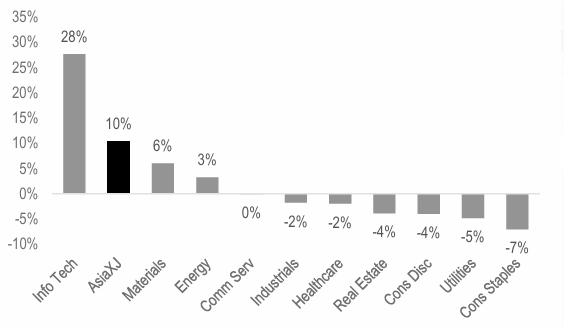
- Asian indices show the same pattern even more starkly. The KOSPI’s earnings recovery through 2025–2026 has been almost entirely a memory chip story (HBM and conventional DRAM for AI data centers). Taiwan’s export and earnings strength likewise tracks AI hardware demand at TSMC and the AI assembly chain (Hon Hai, Delta Electronics, MediaTek). Consensus 2026 forecast EPS for the MSCI Asia ex-Japan universe has been revised up by 10% over the past one month, with the IT sector earnings being revised up by 28%.
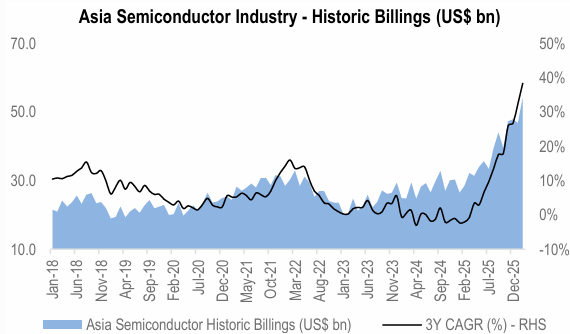
Figure – 9: APAC Semiconductor Shipments Growth at Multi-year Highs…
Source: World Semiconductor Trade Statistics, HDFC TRU.
Figure – 10: MSCI AC Asia ex-Japan 2026 forecast earnings revisions by sector (1M EPS Revisions %)
Source: Bloomberg, HDFC TRU.
Why This Matters?
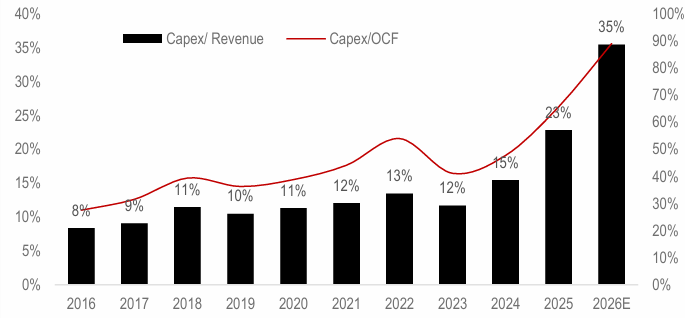
- Earnings sensitivity to AI capex. A meaningful portion of the AI revenue chain is hyperscaler capex spending on each other’s products and inputs. If hyperscaler capex plans are revised, whether due to ROI questions, financing costs, or a step-change in model efficiency (a DeepSeek-type event), the earnings revisions cycle could reverse quickly across multiple index heavyweights simultaneously.
Figure – 11: US major hyperscalers’ capex as % of revenue and operating cashflow (OCF) at multi-year highs…
Note: Microsoft, Amazon, Alphabet, Oracle and Meta. 2026 based on consensus estimates.
Source: Bloomberg, HDFC TRU.
- Geopolitical concentration on top of stock concentration. The world’s most important leading-edge logic capacity sits in a single facility complex in Taiwan. The world’s most important advanced-memory capacity sits in two Korean firms. Any meaningful disruption, e.g., Taiwan Strait tension, export controls, or even prolonged equipment-supply issues would transmit through global markets. These are no longer independent equity allocations.
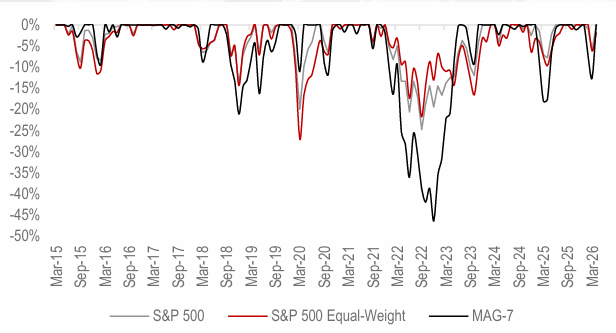
- Drawdown asymmetry. When a single sector controls ~40% of an index, the safety net of diversification disappears. This heavy concentration creates a sharp drawdown asymmetry, where any bad news in that dominant sector triggers a deep, lopsided sell-off. Because the rest of the index is too small to balance the scales, a localized industry slump quickly turns into a major market crash, making the entire index vulnerable to a single point of failure. Historical data is sobering in 2022, when the S&P 500 fell roughly ~20%, the Mag-7 fell roughly ~45%. In contrary, the S&P 500 Equal-Weight Index just fell by ~13%.
Figure – 12: Maximum Drawdown Analysis; Cap-weighted indices outperform on the way up and underperform on the way down when leadership is this narrow…
Source: Bloomberg, HDFC TRU.
Our View
- After years of dominance, the tech sector is seeing its momentum cool as investors seek protection against inflation and look for undervalued cyclical assets. This slow migration signals a broader “Great Rotation,” where the focus is moving back towards the fundamental building blocks of the global economy, such as energy, metals, and industrials.
Figure – 13: A slow rotation has started from the “New Economy” towards “Old Economy”….
Source: Bloomberg, HDFC TRU.
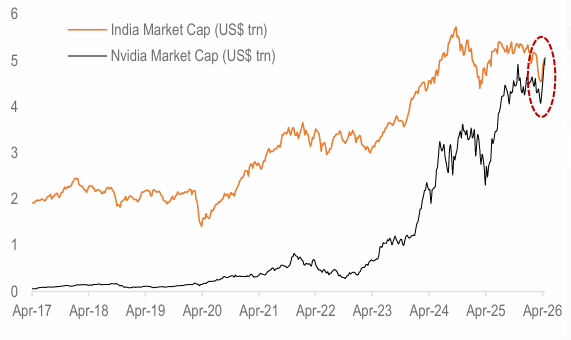
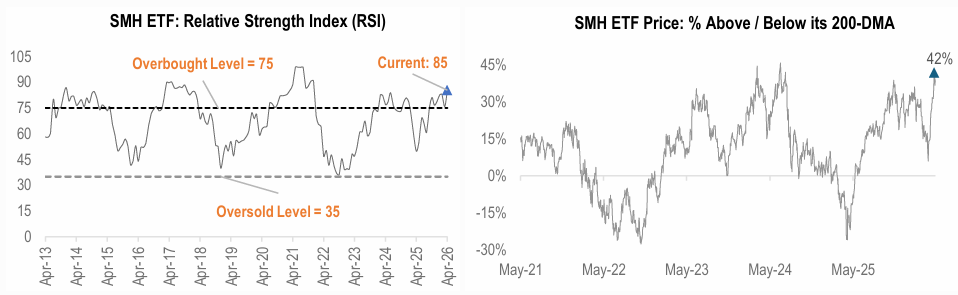
- Global AI / Semiconductor stocks look bubbly. As of Dec-25, the combined mkt. cap of the top-10 global chip companies was ~US$9.5 trn, up 46% y/y from ~US$6.5 trn in Dec-24 and 181% from ~US$3.4 trn in Dec-23. Further, the market cap is highly concentrated, with the top-3 chip stocks accounting for 80% of that total. The Global Semiconductor sector now represents ~15% of the All-country MSCI World market capitalization and is now one of the largest sector weights overall. Infact, South Korea has officially surpassed the UK as the 8th largest stock market in the world, driven by massive AI-driven demand for semiconductors. This is despite South Korea being less than half the size of the UK’s economy. Also, Taiwan has now over taken Canada to become the 6th largest stock market in the world, primarily driven by TSMC (comprising ~44% of the TAIEX and ~58% of the MSCI Taiwan Index). Interestingly, Nvidia is now worth more than India’s total stock market. Even in technical terms, we note that the global semiconductor index (SMH ETF) now trades at extremely overbought levels (RSI ~85) and ~40% above its 200-DMA.
Figure – 14: Nvidia Tops India’s Stock Market in Market Value (in US$ trn)
Source: Bloomberg, HDFC TRU.
Figure – 15: The Global Semiconductor Index (SMH ETF) looks extremely overbought and is trading at >40% above its 200-DMA…
Source: Bloomberg, HDFC TRU.
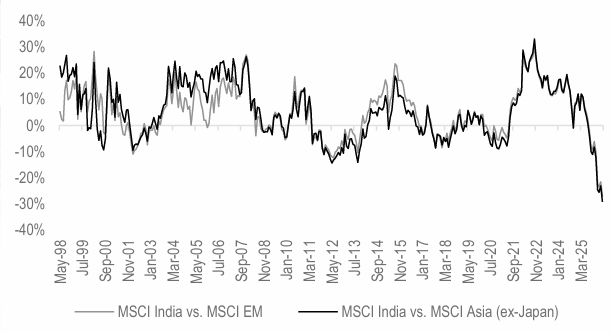
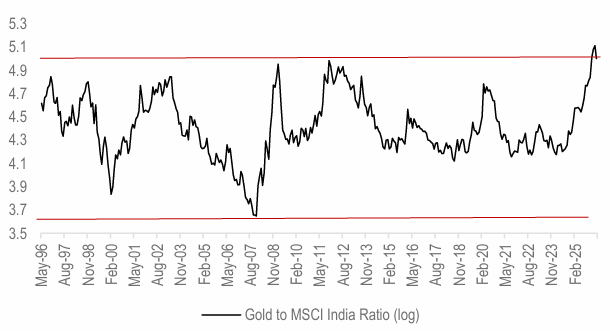
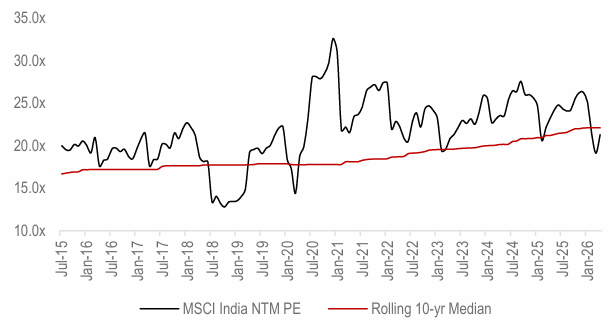
- Indian equities should benefit materially and see a strong “turnaround” once the “AI euphoria” settles down. Over the trailing 24 months, Indian equities have significantly underperformed their EM and Asian peers, by ~30% (unseen over the last 25 years or so). Absolute valuations have retreated to previous troughs, while MSCI India is currently priced near record lows when denominated in gold. Despite these attractive entry points, Foreign Portfolio Investor (FPI) positioning has continued to soften over recent months. However, fundamental indicators suggest a shifting tide. The earnings up-cycle has resumed with notable strength, however conflict-related volatility could see some near-term pressures driven by higher oil prices. This divergence between depressed positioning and improving underlying growth creates a compelling setup for a potential recovery.
Figure – 16: Indian Equities (MSCI India) have underperformed the Emerging Markets (EM) and Asia (ex-Japan) Index by ~30% on a 2-year rolling basis…which is at an all-time low….
Source: Bloomberg, HDFC TRU.
Figure – 17: Indian equities looks extremely oversold in Gold (ounces)…which implies that Indian Equities are at very attractive levels and should outperform Gold over the medium-term….
Source: Bloomberg, HDFC TRU.
Figure – 18: MSCI India is currently trading ~4% below its 10-year median on a 12-month forward P/E basis…
Source: Bloomberg, HDFC TRU.






 2024 HDFC TRU