
From Liquidity Surge to Supply Pressure: Why RBI Turned to OMO Sales
More liquidity does not always mean lower bond yields. Large foreign inflows prompted the RBI to withdraw surplus cash through OMO sales, which also increased the bonds available in the market. With heavy government borrowing and rising macro risks, investors face pressure from both tighter liquidity and higher bond supply. This primer explains the implications for yields and portfolio positioning.
Introduction
India experienced an extraordinary surge in foreign‑currency inflows in 2026, with total mobilisation touching ~$ 144 bn, of which $ 133.0 bn came through Foreign Currency Non-Resident (Bank) (FCNR(B)) deposits. These flows were rapidly converted into rupees, creating a large, durable liquidity deluge in the banking system. Even before the domestic economy could begin benefiting from the easing effect of this surplus, the global and domestic backdrop turned adverse: crude oil prices started inching up, global yields rose to multi‑decade highs, and domestic inflation began firming, raising the risk of imported and demand-side price pressures.
Facing this combination of excess liquidity and rising macro risks, the RBI turned incrementally hawkish and began withdrawing surplus liquidity. It first used temporary tools such as variable rate reverse repo (VRRR) auctions to absorb part of the banking system surplus. In parallel, the RBI’s forex market operations – spot USD sales, sell‑buy swaps, and forward‑book adjustments – helped remove some durable rupee liquidity but could not fully offset the massive inflow-driven spike. Ultimately, the scale of the surplus required a more forceful and permanent response, leading the RBI to resort to Open Market Operations (OMO) sales, which both absorbs liquidity and adds G-sec supply.
This primer explains:
- What OMOs are and how they work
- How foreign inflows expanded liquidity
- Why OMO sales became necessary to absorb liquidity
- How RBI has used OMOs over the last decade
- How OMO sales influenced bond yields apart from liquidity withdrawal
What Are RBI’s OMOs and How They Work
OMOs are one of the RBI’s key liquidity management tools, executed through the buying or selling of government securities (G‑Secs) in the secondary market. In simple terms, OMOs change the amount of money circulating in the banking system and influence bond yields through demand–supply effects.
- When the RBI buys G‑Secs, it pays money to the market – system liquidity increases, and bond yields tend to fall because demand for G‑Secs rises.
- When the RBI sells G‑Secs, the market pays money to the RBI – system liquidity decreases, and bond yields tend to rise because supply of G‑Secs increases.
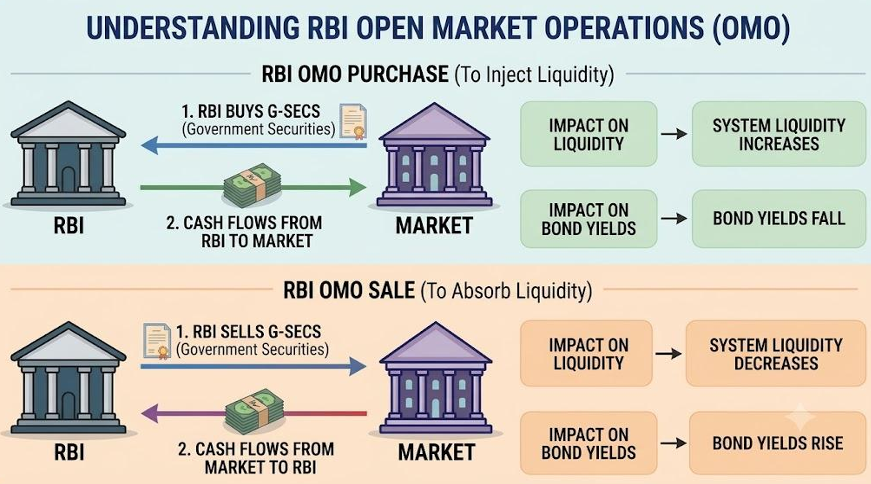
Source: RBI, HDFC Tru analysis
Why RBI Uses OMOs
OMOs serve multiple monetary‑policy and market‑stabilisation purposes:
- Manage durable liquidity in the banking system
- Stabilise bond yields by altering bond demand–supply dynamics
- Shape the yield curve through selective buying and selling across tenors
Although OMOs are primarily a liquidity tool, they directly affect bond yields because they change the tradable supply of government securities and influence investor demand.
How Foreign Inflows Expanded Liquidity
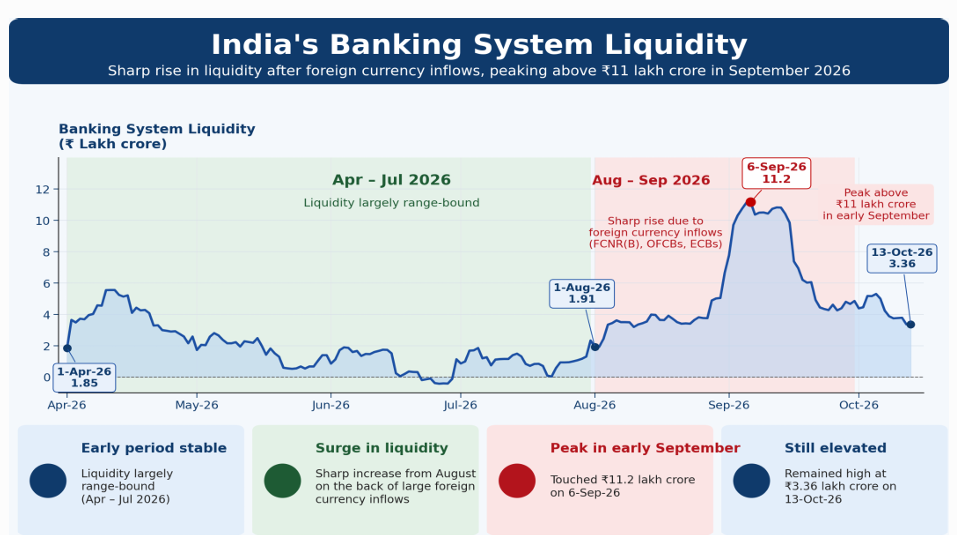
Source: RBI, HDFC Tru analysis
Note: OFCBs – Overseas Foreign Currency Borrowings; ECBs – External Commercial Borrowings
- Apr–Jul 2026 was mostly in surplus but uneven. Late June saw a brief deficit. Liquidity was negative from 22 to 29 June.
- The foreign inflows changed the picture from August. Liquidity rose from ₹1.91 lakh crore on 1 August to ₹11.2 lakh crore on 6 September.
- The RBI first relied on VRRR auctions, forex sales, sell-buy swaps and forward-book management. These operations absorbed liquidity, but the stock of durable surplus remained high.
- During September-October 2026, the RBI conducted OMO sales to the tune of ₹1.25 lakh crore to absorb durable liquidity.
- At ₹3.36 lakh crore on 13 October, liquidity is about ₹7.8 lakh crore (roughly 70%) below the peak. However, it is still nearly double the Apr–Jul average of ₹1.8 lakh crore.
Why OMO Sales Became Necessary to Absorb Liquidity
The RBI required a tool capable of absorbing liquidity on a more durable basis. An outright OMO sale transfers G-secs from the RBI to the market. Buyers pay the RBI, and the rupee liquidity is extinguished unless offset by another RBI operation.
The table below highlights various liquidity management tools and their impact/limitations:
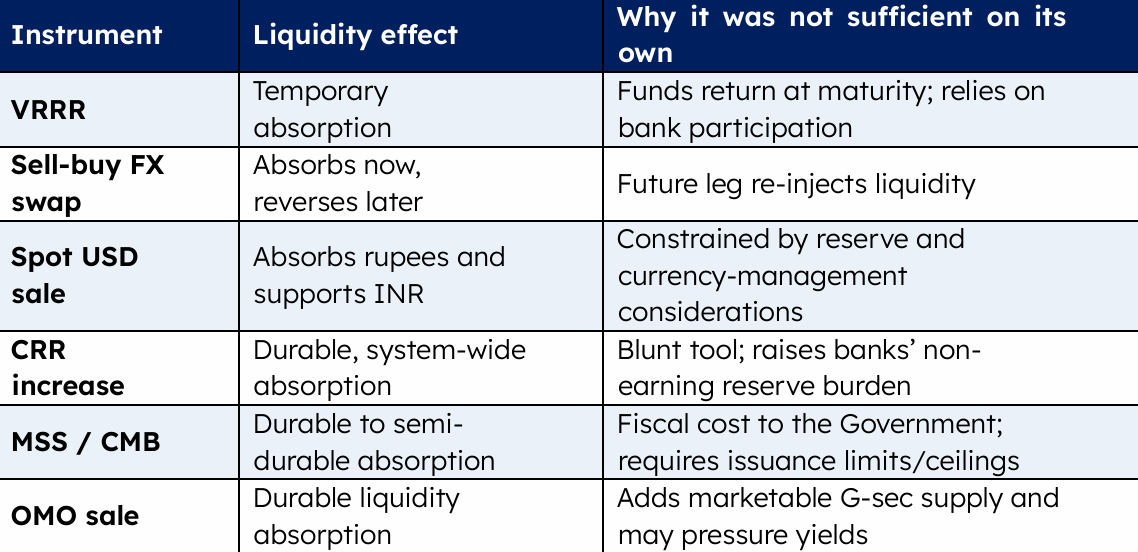
Source: RBI operational framework; HDFC Tru interpretation
MSS refers to Market Stabilisation Scheme; CMB refers to Cash Management Bills;
OMOs in the last 10 years – key trends
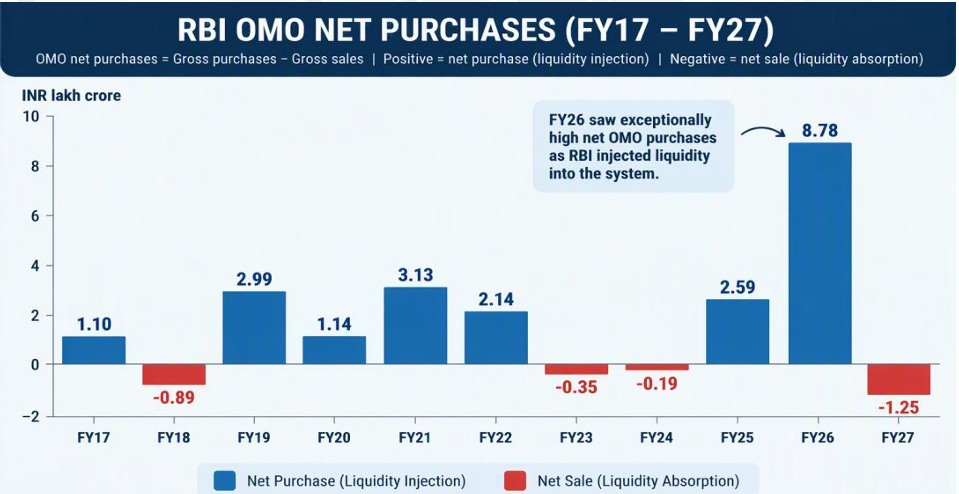
Source: RBI, HDFC Tru analysis; FY27 data till 13th Oct 2026
Note – positive value denotes net purchase, and negative value denotes net sales
- Over the past decade, RBI’s OMO activity has alternated between large liquidity injections and powerful liquidity absorption, reflecting evolving macro conditions such as inflation pressures, currency volatility, and banking‑system liquidity swings.
- Years like FY19, FY21, FY22, FY25, and especially FY26 (₹8.78 lakh cr) saw strong net OMO purchases, signalling periods where RBI added liquidity to support market functioning or offset tightening conditions.
- Conversely, FY18, FY23, FY24, and FY27 saw net OMO sales, where RBI drained liquidity to slow inflationary pressures and tighten monetary conditions.
- Critically, FY27’s net OMO sales of ₹1.25 lakh crore are the highest OMO sales (liquidity absorption) in the entire decade, indicating the RBI’s strong tightening bias in response to the record foreign‑currency inflows, rising global yields, and domestic inflation upticks.
The Bond Market Faces a Dual Tightening
- Additional supply pressure
OMO sales place additional government securities with the market at a time when the Centre and states already have a heavy borrowing calendar. FY27 estimates indicate INR 16 lakh crore of G-sec supply and INR 13-14 lakh crore of SDL supply, taking combined sovereign supply to INR 29-30 lakh crore.
- Tighter liquidity can raise the required term premium
- Lower surplus liquidity reduces the cash available to absorb primary and secondary bond supply.
- OMO sale announcements can directly pressure the securities selected for sale and indirectly reprice adjacent tenors.
- The combination of tighter liquidity and higher tradable supply creates an upward bias for G-sec and SDL yields. Corporate bond spreads may also face pressure if issuance remains strong.
India’s 10-Year G-sec Yield: From Easing to Firming
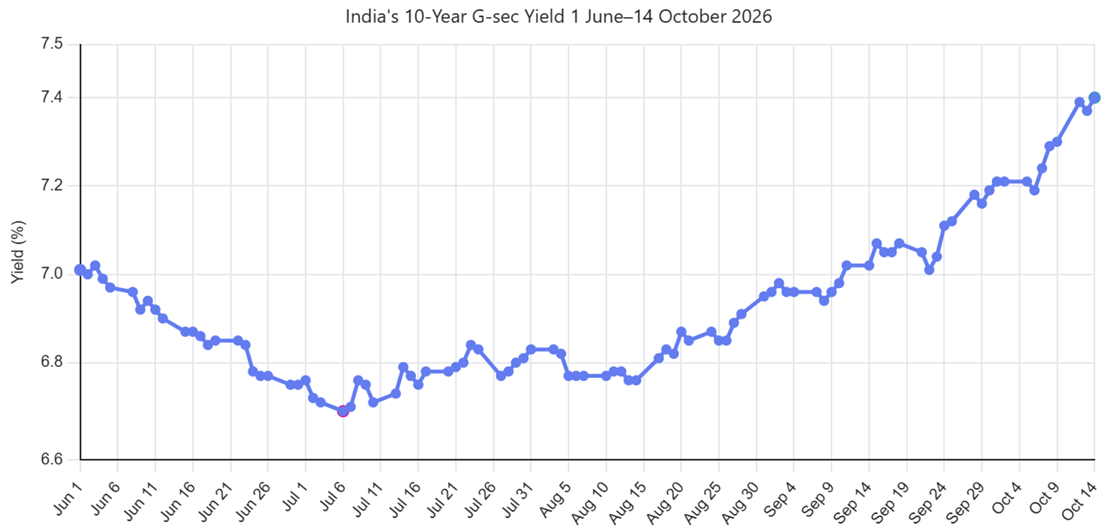
Source: CCIL, HDFC Tru analysis
What It Means for Fixed Income Investors
Our Take
- Durable liquidity remains high even after aggressive forex intervention and OMO sales. More durable absorption may therefore be required if inflows persist or liquidity again rises sharply.
- The near-term risk-reward is less favourable for pure duration exposure in the segments directly affected by OMO supply such as G-secs.
- The G-sec yield curve can flatten further if intermediate-tenor yields rise faster than the long end, particularly if the RBI avoids selling long-dated securities.
- Accrual-oriented positioning in 1-3-year high-quality AAA rated corporate bonds (currently offering spread of 100-160 bps over G-secs) can offer better carry with lower duration sensitivity than longer G-secs.
Key watchlist
- Size, frequency and maturity composition of future OMO sales.
- Other liquidity management tools being adopted by RBI.
- FX reserve movement, rupee volatility and the RBI forward book.
- VRRR outstanding amounts and daily banking system liquidity.
- Crude oil, global sovereign yields, domestic inflation and growth data.
- Weekly G-sec and SDL auction cut-offs.






 2024 HDFC TRU