
The Mechanics of Arbitrage: Spreads, Rates & Market Sentiment

Background
- Arbitrage funds primarily invest >65% of the portfolio in hedged equity positions by simultaneously taking long positions in cash equities and short positions in futures, capitalizing on the cash-future spread.
- The remaining portfolio is allocated to short-term debt instruments, typically in money market securities, which contribute stable income aligned with prevailing interest rates.
- As a result, returns of arbitrage funds are a blend of arbitrage spreads and money market yields, offering a hybrid return profile.
- While debt returns are influenced by short-term yield movements, arbitrage spreads are more dynamic, shaped by multiple market and behavioral factors. This note aims to decode those spread drivers.
Key factors driving arbitrage spreads
|
Factor |
Rising Arbitrage Spreads |
Falling Arbitrage Spreads |
| Equity Market Sentiment | Bullish markets: Strong buying interest leads to futures trading at a higher premium, widening spreads | Bearish markets: More selling of futures compresses spreads |
| Interest Rates | Higher rates: Increases cost of carry, widening spreads | Lower rates: Reduces cost of carry, narrowing spreads |
| FII Hedging/Borrowing Costs | Higher costs increases spreads | Lower costs narrows spreads |
| Category Flows | Lower flows: Fewer arbitrage players, wider spreads | Higher flows: More participants compress spreads |
| F&O Universe Breadth | Expansion: More arbitrage opportunities, wider spreads | Contraction: Fewer opportunities, tighter spreads |
| Market Volatility | Moderate volatility: Creates pricing inefficiencies and wider spreads | Low volatility: Efficient pricing narrows spreads |
| Liquidity in Futures Market | Low liquidity: Increases price impact, widening spreads | High liquidity: Narrower bid-ask spreads, tighter arbitrage spreads |
Source: Bandhan AMC, Invesco AMC
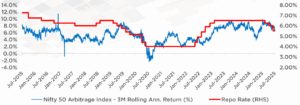
Interest rate cycles are a significant driver of arbitrage spread performance
Source: NSE, RBI, ACE MF
- 3-month annualized rolling return of Nifty 50 Arbitrage Index and repo rate movement has a strong correlation of 0.61 over last 10 years.
- Higher policy rates generally supports higher arbitrage returns. This relationship is primarily driven by the cost of carry component – when interest rates rise, futures tend to trade at a wider premium to spot, enhancing arbitrage spreads.
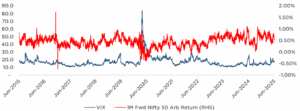
India VIX has negative correlation with Nifty 50 Arb Return
Source: NSE
- A moderate negative correlation of -0.35 between VIX and 1-month forward arbitrage returns likely indicates that excessive volatility or bearish sentiment dampens arbitrage spreads.
- Elevated VIX levels often coincide with risk aversion and unwinding of arbitrage positions, leading to lower or even negative spreads.






 2024 HDFC TRU