

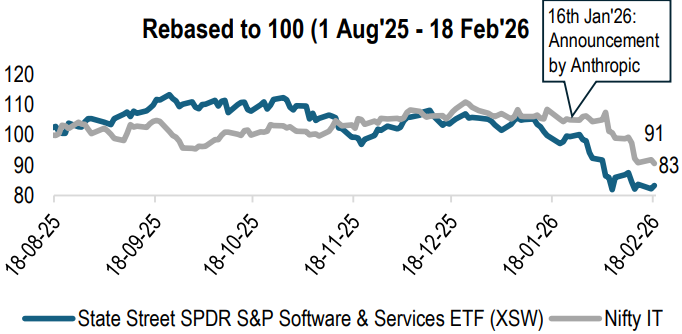
The launch of Anthropic’s Claude Cowork in early 2026 triggered a “SaaSpocalypse” that wiped out approximately $300 billion in global tech market value virtually overnight. The Nifty IT Index suffered its worst single-day plunge since the 2020 pandemic, dropping over 6% on February 4, 2026. This marked a critical inflection point for the industry, as the historical reliance on human intensive delivery faces unprecedented pressure. In this note, we assess the shifting economic reality for tech stocks and provide a breakdown of the sectors most vulnerable to autonomous AI.
Executive Summary
Artificial Intelligence is no longer a future threat – it is a present-day disruptor reshaping the global IT services industry at unprecedented speed. The convergence of agentic AI platforms, large language models, and autonomous coding tools has ignited a structural crisis across technology stocks, labour markets, and national economies. This note synthesises the key dimensions of this disruption and quantifies its impact across global and Indian contexts.
Source: Investing.com, ssga.com
Footnote:

What Happened to Global Software Stocks?
For nearly two decades, software was Wall Street’s golden child. Subscription-based SaaS models, recurring revenue streams, and high margins made software stocks among the most prized assets in investment portfolios worldwide. That narrative began unravelling in 2023 with the rise of ChatGPT and accelerated dramatically in early 2026.
The trigger event was the January 2026 launch of Anthropic’s Claude Cowork – a desktop-native agentic AI that could autonomously manage enterprise workflows, replace entire teams of entry-level analysts, and operate parallel sub-agents for massive data and analysis tasks. The reaction was immediate and brutal.
The Role of Anthropic’s Claude Cowork in the Market Crash
Why Are Investors Selling Software?
The logic is straightforward, even if the speed of reaction has surprised many. AI agents do not need software ‘seats’ in the traditional sense. A single AI instance can perform the work of dozens of licensed software users. This destroys the per-seat SaaS business model at its foundation.
Investors are not just selling individual stocks; they are rotating entire portfolios away from legacy software into energy, utilities, and real assets. Private equity firms including Arcmont Asset Management and Hayfin Capital Management have brought in consultants to audit portfolio companies for AI vulnerability.
Companies whose core value proposition is information retrieval, content generation, workflow automation, or repetitive cognitive work are in the crosshairs. The “AI Crosshairs” – a term coined by Wall Street analysts – describe a dividing line between companies that are weaponising AI and those being consumed by it.
Services Being Disrupted – What Gets Hit and How Bad?
How Do IT Companies Earn Revenue?
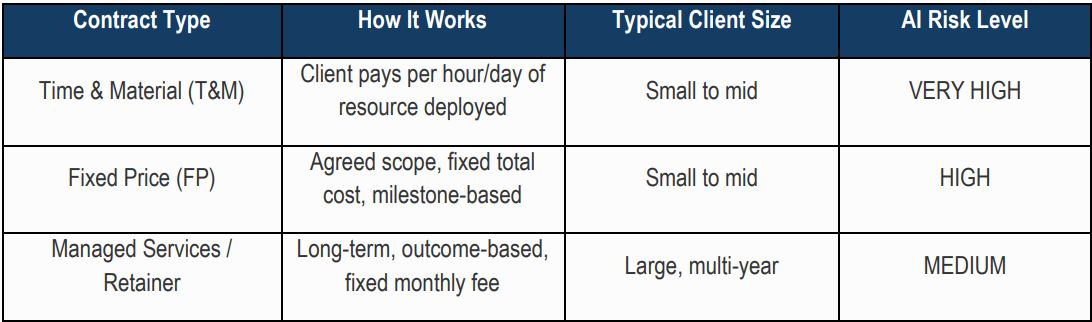
Understanding the revenue model of IT service companies is essential to understanding where AI disruption will hit hardest. IT services companies earn money through three broad contract models:
Historically, the IT industry has been described as a ‘people business’. Revenue growth meant hiring more people.
Is that era structurally over?
T&M Contracts: The Immediate Casualty
T&M contracts are the most vulnerable segment. In a T&M model, revenue = number of deployed resources × hourly rate × hours billed. When AI can do the same task in a fraction of the time – or replace the resource entirely – the billable hours collapse. This is the fundamental economic equation that AI may destroy IT services firms.
Contract Value & Client Segment Analysis – Who Gets Hit First?
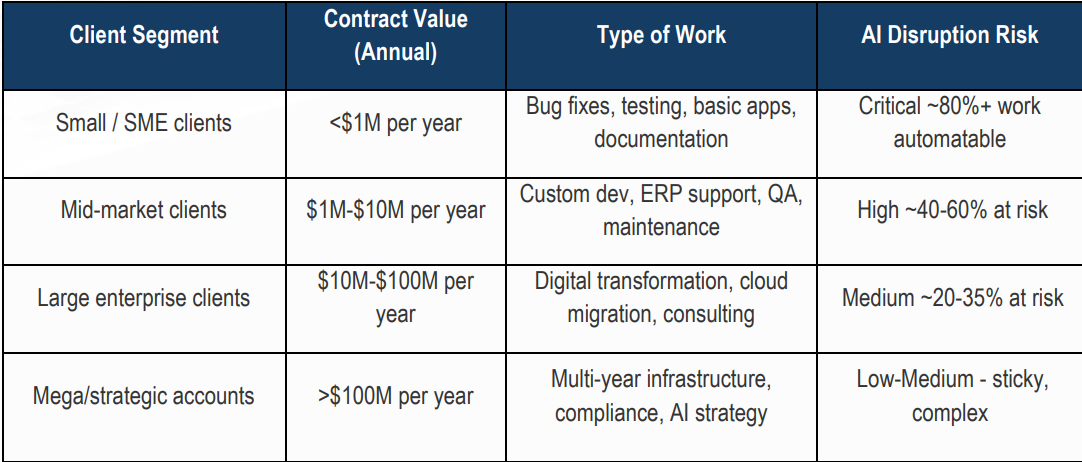
Not all clients will be impacted equally. The disruption follows a clear logic based on contract value and complexity:
Contract Breakdown Over Time – India & Global Context
The historical shift in contract composition tells the story of the industry’s structural transformation. As recently as 2014, T&M contracts dominated the Indian IT landscape, accounting for roughly 45-50% of total contract value. Fixed-price grew as clients pushed for certainty. Managed services (long-term retainers) grew as large banks and insurers outsourced infrastructure. Now AI is reshinking the pie.

Source: Moneycontrol
IT is a People Business – or Was
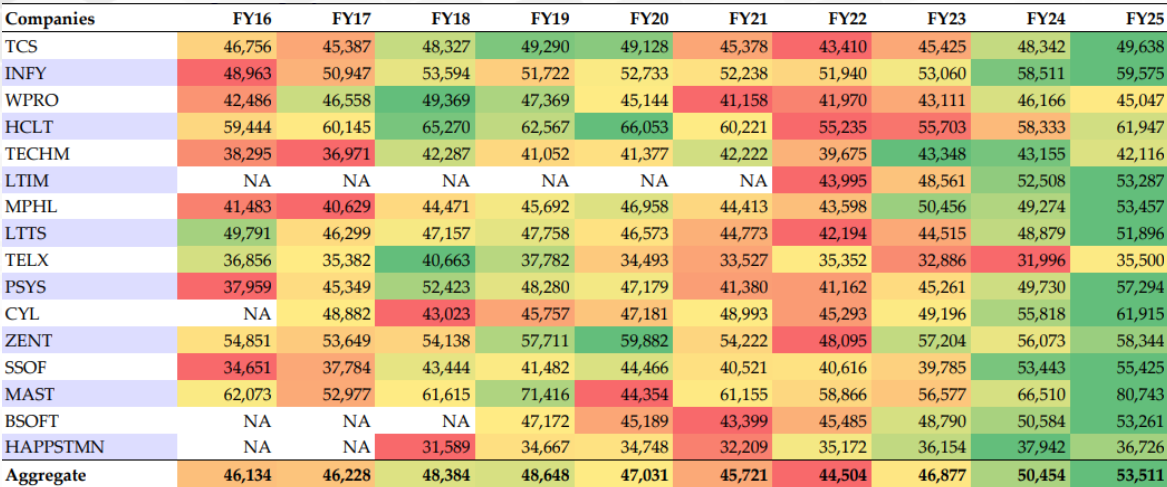
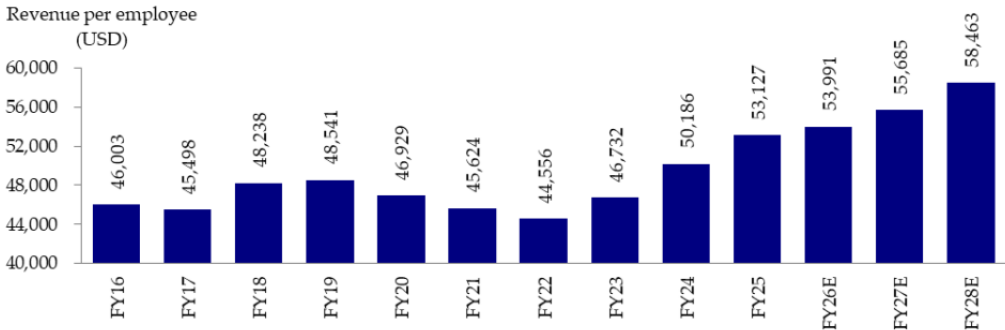
India’s IT industry was built on one fundamental equation: more revenue requires more people. This ‘linear dependency’ on manpower meant that as companies won bigger deals, they hired more engineers, testers, and analysts. The ratio of revenue to headcount was the key metric investors tracked.
Revenue per employee (USD) trend (annual)
Source: HSIE Report (Link)
Source: HSIE Report (Link)
Notice that India’s top IT companies each employ hundreds of thousands of people. This is not just a business model – it is a national employment engine. When AI compresses the headcount needed to deliver the same revenue, the consequences extend far beyond P&L statements.
Knockdown Effects on the Indian Economy
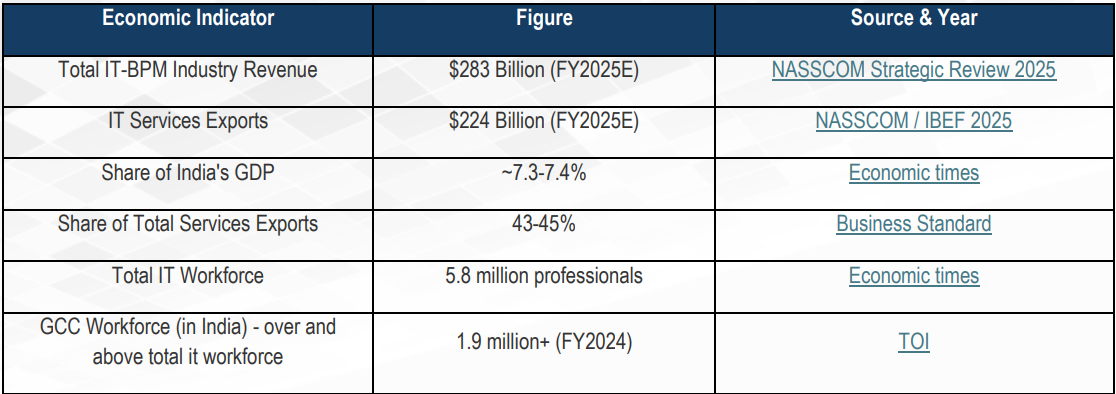
The IT Sector’s Weight in India’s Economy
India’s IT and BPM (Business Process Management) sector is not merely a corporate success story – it is a structural pillar of the national economy. No other emerging market has an IT sector of comparable scale and global integration.
When IT Contracts Shrink, India Feels It
The Multiplier Effect
Every dollar earned in IT exports has a multiplier effect on the Indian economy. IT professionals spend on real estate (especially in Bengaluru, Hyderabad, Pune, Chennai), domestic consumption, education, and services. A structural compression in IT employment would ripple through multiple sectors.
IMF Numbers
What does IT Sector Analyst of HDFC Securities Institutional Equities feel?
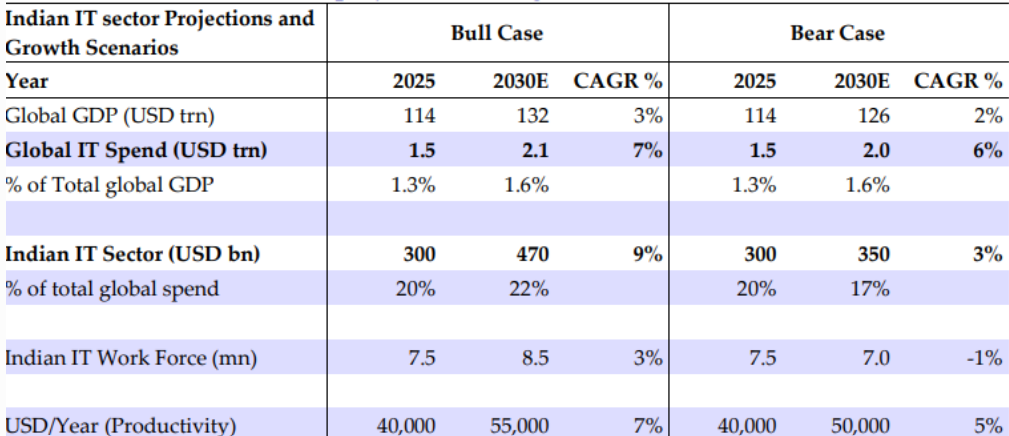
Two key reports were published recently by the HSL IE Team – the IT Sector Report (8th Dec 2025) and the Infosys Report (18th Feb 2026). The December report reflected a relatively balanced outlook on AI’s impact, presenting both bull and bear case scenarios as shown below.
Indian IT sector projections and growth scenarios:
Source: HSIE Report, 8th December’2025 (link)
How has analysts reacted?
In the latest Infosys update, HSL IE IT Analyst has revised the target price downward from INR 2,100 to INR 1,870, reflecting higher uncertainty around legacy compression. Similarly, the FY27-28 earnings projections (EPS) have been reduced by ~2%, with FY27E revised from INR 81.7 to INR 80.1 and FY28E from INR 91.2 to INR 89.3.
Source:HSIE report dt. 18th Feb’2026
Food for Thought…
AI is still evolving, and the path ahead is filled with more questions than certainties. As this transformation accelerates, these are the key questions worth wondering about as we navigate what comes next.
What Happens Next – Adaptation or Attrition?
Will ERP and SaaS companies systematically integrate AI into their platforms?
Will the “human seat” be a liability?






 2024 HDFC TRU